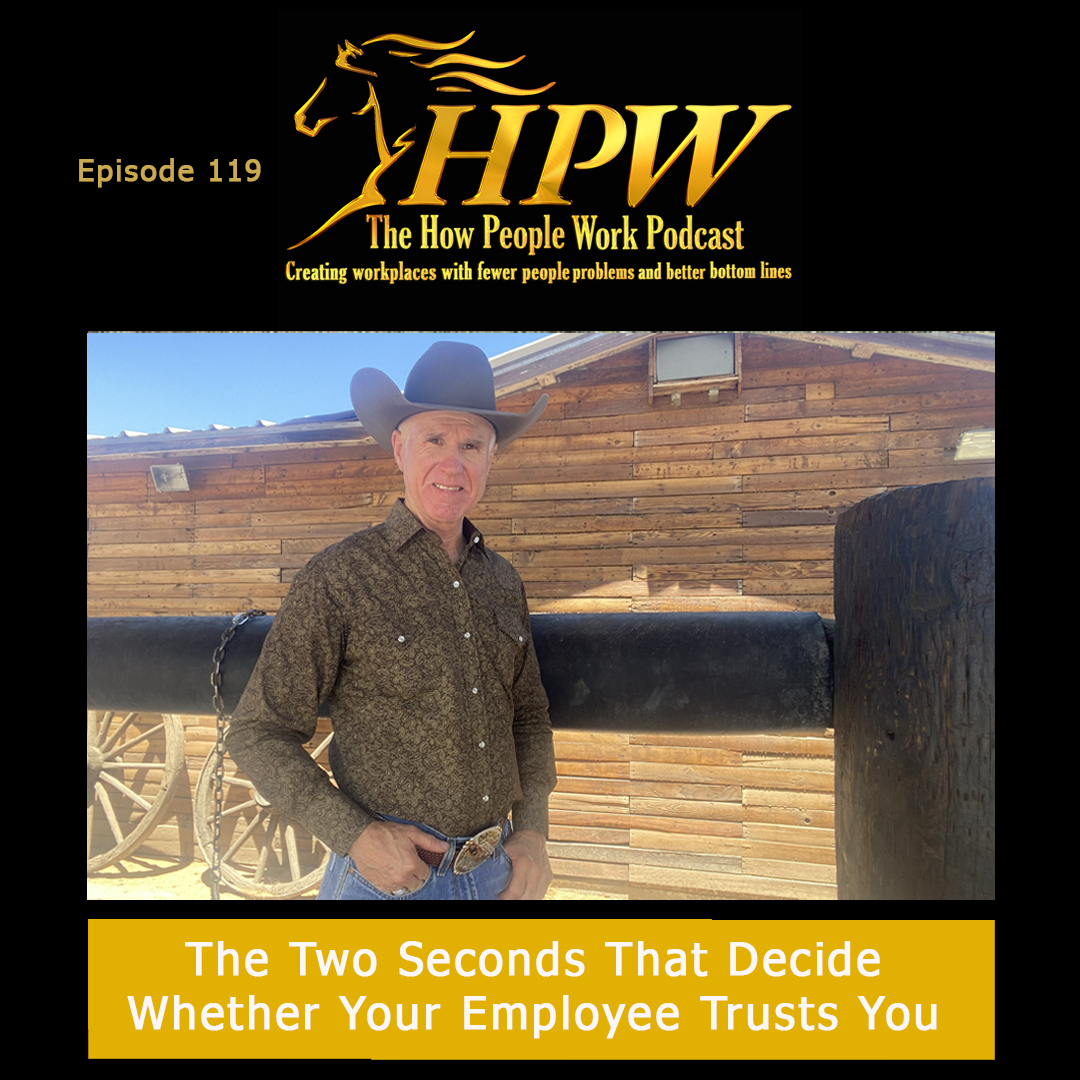
A 1,200-pound horse decides whether to trust you in about three seconds. Your employees? Roughly the same.
In this episode of the How People Work podcast, host Shane Jacob unpacks the Worth Work System, a leadership framework born on a horse feed business and stress-tested inside real companies. If you have ever felt like you are doing everything right and still not getting the results you want, this conversation will show you why.
Shane shares the principle that change everything for leaders who want a team that speaks up, owns mistakes, and brings ideas to the table: Judge the work. Protect the person.
You will hear why 60% of employees admit they have hidden a great idea, a serious concern, or a major mistake in the last year, and what it is costing your bottom line. You will also learn why the leaders who build the deepest trust are the ones who stop trying to hide what they feel and start leading from a different belief system entirely.
If you lead people, this episode is a mirror worth looking into.

Ladies and gentlemen, welcome to this episode of the How People Work podcast. My name is Shane Jacob, your host, and I thank you for taking your time to be here with me today.
Talking about how people work, you know, and sometimes it can be pretty damn frustrating, trying to get people to do what you want them to do, trying to get the results you're trying to get.
Trying to be a good leader when you feel like you're doing everything right and not getting the right results, today this podcast is about the Worth Work System: where it came from, what it means, and why it's important. And so I'll tell you, horses,1200 pound animals, usually more like a thousand pounders, I ride smaller horses usually.
A horse knows whether to trust you in about three seconds. Okay. And here's the thing: when you come into the barn, you think you're gonna try to hide your feelings or your emotions and let it go, and just try to try to snuff it all down. Let's just say that you're upset, you have a little bit of anger, you have a little bit of anxiety, you have a little bit of fear, you have a little bit of whatever the hell you got going on, come to the barn and you're like, well, I'm just, I'm just gonna pretend that none of this is happening, I'm just gonna try to avoid it, to not feel it, to try to go against it. And those are interesting ways of handling emotion.
But when you're feeling emotion, and then you add the conflict of trying not to feel emotion that you're already feeling a little bit, horses know it. They know what's going on. They have to be so hyper observant and locked in and aware of everything that's happening in their surroundings because of their nature, being a prey animal, being, you know, for, for as long as time has begun, as long as horses have been around, they've either got a fight or flight to survive, you know. And domestic horses are no different. They still have that instinct that they need to be aware, it's what's going on, so they can survive. Okay, by fight or flight.
So their hyper awareness keys in on your breathing, keys in on your, I, you, how fast your, your movement, it keys in on the expression on your face, it keys in on, you know, how fast you're walking, how, where your eyes go, keys in on, it seems like they can almost feel your heart rate. You know, like, hey, just took your pulse there, Shane, and I want you to let you know your heart rate's up a bit. It seems like that's their, it seems like they kinda know, you know, they, they probably don't know what your heart rate is, but I think by the way that you're acting, they kinda get, they have a sense that something is, puts them on alert. You're on alert because your heart rate's up. You're on alert because something's wrong. You're on alert because something's edge. So then they get on alert. Then they think something's wrong. And then that's when things don't go as well as you want to. Ever. So, we do the same thing with horses.
Now, people, human beings are definitely, we don't have to be as aware to survive. We don't have to be hyper aware of everything, of every minute moment. But you know, our brains pick up and feed our, our brains, and our eyes pick up and feed our brains information that it's not necessarily a conscious thought will be formed. Sometimes it will and sometimes it won't, but our brains are picking up what people are putting down.
I began to say not as hyperaware of horses, I believe that we're not as hyper aware of horses and that, because that we don't need to be to survive, but people know what's going on. Okay. A lot of times we think that, that people won't notice all of our internal, whatever angst, it, whatever's going on inside of us, that people won't notice, but they do, because it comes out, you know, it comes out in our words, it comes out in our actions, all the ways that we communicate, people can sense, they have a sense of what's going on inside of our minds and our hearts. So why this is important is that trust, horses know when how to trust us. They'll decide if everything's going to be okay in three seconds or less.
People are at about the same thing. Your employees know. If you're a leader, your employees know what's going on with you. And it doesn't, it takes about the same time, about three damn seconds, not very long. Now, when a horse doesn't trust you, there's a pretty good chance you might end up in the emergency room. Okay. Because when they think something's wrong, they sense that you, because they sense you think something's wrong, so they think something's wrong, so they start acting like something's wrong. And they might, you might, they might jump out away, they might, you know, run onto you or knock you down or jump out from underneath you, or, you know, just try to get away from something that may not even be there. They're just like on edge. Okay. And so a lot of accidents and injuries happen with, they actually happen as a result, as, as of us, excuse me, as we human beings putting horses on notice that something's wrong, they start acting that way, and therefore something becomes wrong.
When employees don't trust us as leaders, we usually don't end up in the emergency room. Sometimes we do, but not too often, right? So what they do is they just clam up, you know, they start, they don't take risks. Now, they don't speak up. They don't, they don't tell us what's going on. They don't communicate hardly at all when they don't trust us.
So we've talked about this before on this podcast, but there's so much at risk at a person's work. You know, there's the stakes are so high because of, hey, it's our money. You know, your job is your money, your career is, it's, it's who you are sometimes. We attach who we are to what we do for a living. And you know, our mortgage and our kids and all the things that depend on that money coming in, it's all, we feel like it's all at stake in those moments. And so we're, we don't, if we don't trust at work, if we don't trust our coworkers and if we don't trust our leaders, we don't, we don't engage much. What I mean by that is we don't, we don't, we don't take any risks. We try to reduce the number of risks.
Risks could be something, could be, okay, if I have an idea, if I have, if I'm an employee and you're the leader, and I present you with my idea, my recommendation, hey, I've been out here in the middle of this, and it looks to me like we should do it this way rather than this day. I mean, what do you think about that? So I presented you my recommendation. To me, that may be, I may perceive that to be that I just expose myself to a tremendous risk. Why? Why would I have this thought? Usually, again, it's not a conscious thought, but I'm not doing it because I'm afraid of what might happen. And so, what might happen? What would the risk be? You're gonna think I'm an idiot. You're gonna roll your eyes, you're gonna say that's stupid, we've already tried it, and then, because you didn't accept my idea, or because of how you reacted, I'm gonna take a meaning that says, my idea sucked, you think I suck.
So here I'm the employee, I give you an idea, you don't implement it. Now, maybe you've already implemented it before I started working, you had valid reasons, you, you know, the idea was just something that you had tried, and what we're doing now works better. So it's, it's really not about the idea most of the time, and it's usually almost never about the person, but the person who makes the recommendation makes what happens with this recommendation mean something about them. Okay, so in this example, you don't implement my recommendation, you say we're gonna keep doing it the way we are doing it, we've already tried that and it didn't work. So now I make that mean, I may, there's a lot I can make it mean whatever I want, but a lot of times because the stakes are so high, because I feel so vulnerable, I might think that because you didn't accept my recommendation and implement it, that you think less of me. And that's a risk. Because I don't want you thinking less of me because this is my job and I need you to think that I'm at total badass, so you'll keep giving me raises so I can keep paying my mortgage. So I'm just not gonna say nothing. I'm not gonna take any risks. No ideas, no innovation, no improvement, no reporting from the frontlines, no nothing. I'm not saying nothing. Just keep the status quo, smile, and we're just not gonna make very much improvement. This is just an example.
But people, just when they don't trust you, they stop giving you your best. And they start, stop participating, you know, and they stop being as honest, really. And, and that's just a fact. Okay. People are not as honest. So let's just say that I recognize that I made a bad decision, or I see something that's wrong, same thing. I'm not gonna say anything. You might think something about me, and that could feel risky to me. And I have so much, I'm not gonna do nothing. So I do nothing, right?
Lack of engagement's a big deal. Gallup says that like 80% of, in the, in the world workforce, people feel disengaged. I'll find the exact quote in just a second. But engagement's a big deal. An example of engagement, if you're not familiar with how engagement works, is let's just say I'm in the medical industry, I'm in the medical, I'm a medical professional. And say I'm a, an attendant, or even a nurse, or who knows, I'm a, I care for patients in some way.
And I see something about the care of this patient that I'm like, mm, I don't know if this is right. I don't know if this is good for the patient. This could be detrimental, let alone fatal, and I don't say anything, and something goes bad, and something's permanent, or the person dies. I mean, you can see this is, these things happen. Yes, it's an extreme example, but these things happen all the time. And so the better communication that we have and the more engagement that we have, the better. Okay, and productivity goes up. You, this is proven time and time again with lots of studies. I'll give you some information, but when the trust level is low, engagement is low, people don't say anything, they don't report anything. They don't participate in the solution, so productivity goes down.
And it's really bad news in the company. You know, I've given some examples of people here at my company, my horse feed company here in Las Vegas, Nevada, that don't report, don't say anything when something breaks, a piece of equipment breaks, a vehicle has a problem with it, and, and it could be anything, but something, something breaks. We'll call it a piece of machinery or equipment breaks. And for many reasons, but mainly is the lack of trust. Sometimes it's a lack of, them not knowing the importance of it. But a lot of, a lot of times it's the trust. And so when people don't report once, then something breaks down. They don't want to be, they may not want to be blamed for, they might think there'd be a negative consequence because they'll be blamed for the one that caused the problem. And so they just kind of put it together the best they can to get by and don't say anything. They might fix it with duct tape or baling twine, or if it's a leak and hose, they might put, you know, tape on it and say it's fixed. These are just examples of not reporting something that's broken if the company's asked you to report what's broken, because of the risk that you're, you would be giving yourself. It's easier just to do nothing, or to fix it so you can get by and don't say anything. Don't admit that you did it. Don't blame anything else, anybody else. Just do nothing. Okay.
And what happens is then things start to break down. We have more injuries, and productivity goes, just goes way, way, way down. Okay. Research has shown, and let me see if I can find what research, give me one second, research has shown that 57% of employees, let me find the number here. I thought I had it right in front of me, but I, I don't have the, we'll try to get the source in the, in the show notes. But fifty percent of, fifty-seven percent of on-site employees deal with aggressive gossip, personal clashes, and toxic back channeling on a continuous basis because when they're not engaged, they're afraid to speak up, so they start speaking more to each other, they start speaking out to each other. And then we have a lot of people drama inside the workplace.
The number before that, that I was looking for, was that 60% of employees have withheld a brilliant idea, a critical concern, or a major mistake in the last year out of fear of judgment or looking disruptive. Okay. 60% of people, of employees, have with, withheld a brilliant idea, a critical concern, or a major mistake in the last year out of, out of fear, okay? Out of fear of judgment, what somebody will think about them, or out of looking disruptive, of what, basically the same thing, of what somebody will think about them. So they say nothing. The statistic I said before that is a result of saying nothing, they don't speak up, so they speak out to each other. And then this increases the conflict in the workplace. And conflict in the workplace, gossip, personal class, backchanneling continually. Okay. And this is just such a time suck. None of this goes to productivity, none of this gets us to the goals that we're trying todo. And none of us helps, none of this helps the reason that we show up at work, get better, for you, for the employee, or for the leader. None of it. Okay.
When sixty percent of employees go to work scared, scared to speak up, scared to be blamed, scared to get it wrong. Okay. And it's not because leaders are scary. It's because we're human beings and building trust is a learned skill. You know, I think we all know that trust is like, yeah, I want to have a high trust culture, a high, plus high trust workplace. I want my people, my team, to trust me and I want to trust them.
I don't knowhow much we've really thought about trust them to do what, or to not do what? What exactly do you want to trust them to do or not do? Most of the time we want, we want to trust that we are safe from value judgment. Now that's not said out loud, and we, a lot of times you hear that and you don't even, what the hell I'm even talking about.
So it's not like you, well, I don't, I'm not gonna say anything because I don't trust, I'm safe from value judgment. That's not how it goes. Internally, it sounds more like this. I'm not gonna say anything because I'll get blamed. I'm not gonna say anything because they'll think I'm a problem here. I'm not gonna say anything because they'll think I'm, I'm a certain way. I'm lazy, I'm, I don't pay attention, I'm not good enough at my job, blah, blah, blah, all these different things. They'll think they'll place a value on me and the way I am, who I am, okay, because of this thing. So I say nothing.
Developing trust, we want our people to trust that they're safe from value judgment with us. And what that means is regardless of what they do or don't do, that we're gonna hold them in high regard and high respect, that we're gonna recognize that they're human beings. They're gonna make mistakes. Not only are they gonna make mistakes, they're gonna make bad decisions, a lot of bad decisions, and that's gonna be part of the deal. And it's never gonna be right. It's never gonna be a hundred percent. We're gonna continually be improving and working on and iterating and amending and improving and adjusting and reevaluating and changing. Constant change is kind of, it's kind of hard to deal with, because our brain wants, it feels safe in certainty. So, and a lot of times if we're not careful, people can feel like they can never get it right because it's never good enough. And then they think that they're not good enough, or their leader thinks they're not good enough.
So we set an expectation of constant progression, constant improvement. More importantly, that's part of the deal, but also part of the deal, and even more importantly, is we want them to trust that no matter what they do or don't do, and in all the things that they do wrong and all the failures, that we will never negatively judge their value based on their behavior, based on what they do or don't do, no matter what. Okay. And that is a task for a leader. You want to be a badass leader and only judge the work and always protect the person, when it goes contrary to what you've been believed your whole life, it's a task. It can be done, and the rewards are tremendous.
If you can train your brain to always hold people in high regard, we want our people to trust and to really come to know and believe that we as leaders, the people in charge, don't value ourselves any more than anyone else in this company or in the world. If they believe that, we're starting to build trust. Okay. We're starting to have people feel more comfortable because they trust, psychological safety, they feel safe, they feel like they, that they can trust us. And so guess what happens? They start to open up. They actually start to smile more. That's an interesting fun fact of the day, side note. Low trust, when we have low trust, our managers are just running around spending time trying to be the referee of all the kids in the playground that are fighting. Okay. Teams lose thousands, our employees lose thousands of hours every year to conflict, gossip, back channeling, and just people drama, people friction.
Gallup says eighty percent of the global workforce is checked out or disengaged. I mentioned this earlier. The actual statistic, Gallup says 80% of the global workforce is either checked out or disengaged, costing the economy $10 trillion every year. And the question isn't like, that's a great big number, I wonder who that's affecting. The question isn't whether it's happening to you. If you're a leader, the question is, how much has it already cost you so far this year? Okay, that's the question.
Now I have, for a little bit over 30 years, I've been building trust relationships with horses. And and I've led people in my own companies. And at the very beginning, I said leading people in my own companies can be so frustrating. And most of that time that I've been managing and leading my own companies, running my own show, being the boss, trying to manage and lead people to accomplish the goals that we're trying to accomplish with this company has been a damn frustrating project, to say the least. Sometimes I mean I'm about to pop a vessel a lot of the time. So I have a lot of experience in how not to do things. And I've tried a lot, a lot, a lot of things, and some of them work to varying degrees.
But what has been a little bit, a lot less frustrating, is building trust relationships with horses. Okay, because what I found out was that the same principles that I use with horses, and that we as horsemen use with horses, professional horsemen use as horses, that create trust with horses, also create trust in humans, and they, they that trust creates a high-performing team at work. Okay, and engagement shoots up. Trust goes up, engagement goes up.
You know, like I said, I got this wrong for so long, for so long. Eventually I went back. I went back to a prison cell that I was locked up in. And when I learned about what judgment does to people, what my own judgment did to me, and what other people's perceived judgment did to me and what I observed in other people, I also went back to horses. Like I mentioned, I went back to horses where I learned what makes a willing partnership, where I have a willing partner that I can trust. And I went back to my own companies and I put it all to test. And out of everything came one principle, judge the work, protect the person.
That's the principle, the main principle in what I call the Worth Work System, the Worth Work System that I talk about, there's basically four elements of the Worth Work System. The number one principle is that we judge the work and protect the person. That means that no matter what people do, we always hold them in high regard and with 100% respect. And when we don't, because we're human beings, we go back and fix it. We go back and we, we apologize, we ask for forgiveness, we make restitution, we make, we make things better to the extent that we can, because we're gonna, we're not gonna be 100% at it, but we can get very good at it. And when people feel that they're safe, things really start to change.
I talk about a lot about the breakdown and all the frustration and how bad things can go and how low productivity and how expenses can be through the roof and how all the negative things that happen because they do. If you're a leader, you know what I'm talking about. The positive side of this, okay, and this isn't, the Worth Work System is not just like, here's a cute little system with some kind of, you know, four points in it and just do this and everything's gonna be hunky damn dory. That's not what I'm talking about, my friends. I'm talking about a fundamental belief system that starts, that must originate inside of your own heart and mind. Okay, because the Worth Work System says that you hold every living being equally. You and you, and you and you and you and you and, and all the people on your team, in your company, in the world, are one hundred percent equal.
I mean, just that alone is a big kind of concept just to consider to be. Because if you believe that you're better than the people that are working for you, that you're leading, if you believe that you're superior, if you have arrogance in your heart and your mind, the trust is not going to be there. Remember where we began? The horses know, so do they. Guaranteed.
That's a big concept. And that takes practice. It takes knowledge. And then it takes practice. Practice, practice thinking, practice applying until it becomes part of your belief system, until you firmly believe that all human beings are equal, and that you're equal. It begins with you. If you feel you're not good, you know where superiority and arrogance comes from? It comes from, I hate to tell you this, man, you're not gonna, this might not go over well, but I'm gonna tell you where it comes from, is your lack of your own self-beliefs. You think you're deficient a little bit in some way. So you're constantly trying to prove to yourself and to the rest of the world that you're good enough, that you're better. But and but by putting yourself out there as better, thinking, acting, and knocking people down and, and, and, and doing things that show that you think that you're better than other people, feed your brain back the idea that you're good enough, but it's never good enough because your brain inherently knows that that you shouldn't be treating other people that way. But it comes from a lack. It comes from a lack of confidence is a way, is one word to say it, but it comes from thinking you're not quite good enough in some way. Okay. So you, this begins with what you think about you.
What you think about you, if you beliefs are thoughts that we repeatedly think, and we continue to prove to be true, and then they become a belief, these are thoughts that we repeatedly believe, that we repeatedly think until we believe. So we must begin with a belief that we're firm in our own value, that we're good enough, and that what we have to fully accept and forgive ourselves, and we have to believe that we're 100%, that we are 100% value. Just that step alone helps us look at the rest of the world the way that we look at ourselves, because the way that we relate with our, to ourselves, is the way that we relate to the world. So when we see, when we come to believe, because we practice thinking that we're good enough, we see the other world, the rest of the world is good enough. We don't have to be superior, and we don't have to, we can shed all the arrogance and all the I'm better than you, or any of the stuff that's rattling around in our mind, because they know, people that we deal with know. Okay. These are big concepts, my friends, and but this is what makes outstanding leaders.
The second part of this is that what I call the separation skill, second part of the Worth Work System, where we clearly say, and we come to believe, we practice thinking, and we come to believe this, that what people do has no effect on their value as a human being. Okay, no matter what they do or don't do. Period. End of story. Okay. Yeah, Shane, even if they did that thing that you don't want to talk about, even if they do horrendous things that you judge to be wrong, things that you judge to be, well, evil, things that you judge to be just the worst things that you can think of. I'm giving you this example because that's what people say to me. And I say, yeah, that's right. Regardless of what people do, it either, either behavior, either what we do affects our worth as a human being, or it doesn't. Regardless of what it is. Okay. So this is a decision that I'm asking you to consider and to accept.
The idea that regardless of what people do or don't do, we can hold them in perfectly high regard. It doesn't have to change the way that we think about their worth, is that we can still love them. We don't love what they do. We don't accept what they do. We don't condone it. We don't absolve them. They're self-responsibility. They're still accountable. We don't like it. We don't, we still must judge the work or the behavior. In this world, we must, I mean, what we do matters, and what other people do matters. What we do, our behavior, matters. We're here to test our own behavior. If you're asking me, we're hereto be tested on our behavior. I mean, that's why we're here. That's why we show up at work, right? To do the things that are going to move this company forward so we can get the things that we want in the end. It matters. It all matters. It all matters.
So but it doesn't have to unless we deem it to be so. Okay. Because this is an internal decision. It's not, there's not a, there's not somebody, you know, that's assigned by the President of the United States that says, well, if you do this, you're an idiot, or if you do this, you're this or that, or whatever, or you're just not good enough, you're not as good as the rest of the people if you do stuff like this. Or that if you, if you keep screwing up on this, if you don't follow instructions good, you're just, you suck. What, all the different value judgments that we can place on people, okay? Your work can suck, that's for sure. What you're doing is not working out. We need you to change it. But you, my friend, you're a hundred percent all the time, regardless of what you did. How can I help you do better? So these are big concepts.
And if you want to change, you can. If you want to change, if you want to fundamentally change and have massive results with your team and your people, it's going to begin about in your own thought process about what you believe about you, and therefore how you relate to the world. And as we make less value judgments about our people and as we value them equally, and as we always agree and work towards always protecting the person, meaning not making value judgments, as we move that way, the trust goes up, and it doesn't take decades, it doesn't take years, it doesn't even take months. Each little interaction matters, and it builds, and it builds, and it builds. And in the course of a day, you can make massive projects, progress, one conversation, you can make massive progress in the trust relationship.
You say well, we have a high trust workplace. What does that even mean? Well, if you go into our workplace here, let's, at Jacob Livestock, at my horse feed company, we'll call the workplace where most of our work is done, is what I call the hay yard over there, okay, where all the hay is stored, and the trucks, and where the customers come and all that. That's the yard, okay. So we'll just say that's the our workplace. We're also delivering all over the place, but this is the main center, the primary hub, we'll call it. That's the workplace.
Well, we have a high trust workplace. What does that mean? If you walk into the yard, you're automatically in the high trust zone. I mean, I want you to think that, but there's no different air over there than there is over here. It's the same air. I mean, it's not, it's the same kind of air, we'll say that, because I breathe it the same as I do here, as I do over in the yard, except for the windblows, it gets a little dusty. And sometimes if you have hay allergies, there's that. But what I'm, my point I'm making, is that high trust workplaces are simply individual relationships inside of groups, inside of, r, workplaces, that the trust is high. Okay. We want to say in our workplace or our we always judge the work and only, we judge the work and protect the person.
Okay, and that's what we go for, and we want to all believe it, but nobody believes nothing until we start making these little incremental interactions with people where we respect and regard people, and there's consequences, and but we only judge the work and we always hold people in high regard. Yep. We honor their perspectives, we treat them with total respect, and we never make what they door don't do mean anything negative about their value.
I'll talk, and what does that mean? That means I'll give you another example. You had a work accident. You got in an auto accident at work. Okay. Now, that means, does that mean that I can't trust you? Does that mean that you're a horrible driver? Does that mean that you don't pay attention? Does that mean that you're not a good driver? Does that mean, I mean, all these things, what those things are called, those are value judgments. So is, you're an idiot, you're careless, you don't care about this company, all these things that are value judgments. Okay.
So let's just say that one of my paid delivery drivers goes out and gets into an accident. What does that mean about that person? Here's the way that, what judge the work protect person means, that when that happens, and it happens, what it means is that they're a human being that had a result that they're not happy with. And by the way, I'm not happy with either. But it doesn't make them a certain way. We need to judge the work. So the first thing I'm gonna do is protect the person. I'm gonna back it. I'm gonna turn this around. I'm gonna protect the person first in my mind. I'm gonna say, hey, this is not a desirable thing. This, the, the work, the behavior has got to change. We're gonna have to do something. There's probably gonna be a consequence for what's already happened, but I'm not gonna make this mean something negative about the person.
Now I go talk to him, and guess what's in my heart and soul? They're picking up, like that horse did, you know what? They're picking up acceptance. They're picking up the fact that I know, because I make mistakes and I've done stuff, okay, in my lifetime. And I've made probably worse mistakes than they have. I've made plenty. You know why? I haven't, I've probably made way more than my share of more even egregious things than they've ever done. When I go to them and I'm feeling respect and regard and not disdain and disgust, they know it, just like the horse in three seconds, they know it.
So when I go to them and I say, hey, glad you're okay, this isn't about you, so just know that, I, I respect and regard you and not gonna make this about you, not the way we roll here. The only thing that we're here to talk about, besides to celebrate the fact that you didn't get injured, and luckily no one else did too, is that what we need to do, to make sure that this doesn't happen again. And you know, we're just gonna, if there's consequences, we're gonna deal with the consequences straight up, and with, but with respect and regard for that individual. Now you want people to line up for you and take a bullet. You don't roll over, it doesn't mean that what they do doesn't matter, it damn sure matters, and that there's gonna be consequences, and it's not gonna be a good time. It's not going be a fun day. But you know what? They're going to walk out of there and they're going to have more respect and more trust for you. And that, this is what judge the work, protect the person means. That's an example of how it rolls. Because they know, just like the horses do.
When I go out and I train, you know, companies and people in companies and teams and leaders, this kind of work, the fundamental beliefs that it takes to make a shift inside of ourselves is the first thing that we work on. Then we work on the implementation, how to recognize when we're making a value judgment, how to recognize when we're frustrated, when we're angry, what the thought is, what we're making that mean, about wherever the problem, who the problem is with. We talk about how to rethink it, how to change the thought. And then how to, how to respond, how to implement the worth work, that it responds to clear actionable steps of how to do it, in little ways, like that example I just gave you about whoever wrecked this vehicle. Judge the Work, Protect the Person. The results are magical. They are magical. This, this isn't easy work, because this is about you.
A lot of times we go to work and it's like, I'm sick of these damn people, I, you know, we blame everything except for looking inside of here, where our power is. And so these results are, they take effort. They take effort because it's going to be what you believe and then implementing what you believe. Okay. But the big shift, big shift, yeah, the big change is within you. It's within your heart and your mind. And as you change, you will watch the world around you change, and it will be, it's amazing. It's amazing to see how people smile more. And how they start to open up and how you start to find out things that you never would have known, and that you, people engage more on a lot of different levels. Okay. And they also have less, less conflict with each other. They get along better, they cooperate better, they collaborate better. You don't have all this backbiting and, you know, you're sitting in a meeting and somebody's down there, you know, on their phone saying what an idiot the other person is who's talking. I'm sure none of you have experienced anything like that ever, but yeah, don't have all this gossip, and, the rewards in, first of all in the peace of mind and the way that it feels to trust, feels good. We'll just say that.
Now you've experienced trust, you know what I'm talking about. You've trusted somebody, or you trust somebody right now, you have a high trust level with somebody. And trust feels good. Okay. Fear, fear doesn't feel good. Now I'm not saying that we should always feel good, that's not the point of this. I'm saying that when we feel good, when we feel calm, when we feel at peace, because we feel trust, when we feel connected to that other person because we trust them, it feels good. And when we feel good, we start behaving differently, better. We start improving. We start making those recommendations. We start getting active and being part of the solution instead of the problem, and engaging, and just the participating and the engagement and the ideas and the innovation and the things go smoother. And I mean, all this stuff is coming at you when it's been held back, and you had to go out there and dig, and dig and dig and find all the problems and discover them and be shocked and amazed with all the things that were happening that you didn't know about, all these negative results, because nobody's saying nothing. They're not saying nothing, man. And it's expensive.
So the Worth Work System works. The playground, the testing facility, is the yard I talked about, where I implement all these systems on the test mode. And then at this point, lots of companies are implementing it and having incredible results. I highly recommend the Worth Work System. So check out shanejacob.com. Stay with us, keep track of the podcast, watch us on social media, connect with me on LinkedIn. Appreciate you being here. Remember, my friends, your value is non-negotiable.
A horse decides whether to trust a person in about three seconds, and according to leadership coach Shane Jacob, employees do the same with their leaders. In Episode 120 of the How People Work podcast, Jacob explains his Worth Work System, a leadership framework built on the principle "Judge the Work, Protect the Person." Jacob cites research showing 60% of employees have withheld a valuable idea, a serious concern, or a major mistake in the past year out of fear of judgment, and that Gallup estimates workplace disengagement costs the global economy $10 trillion annually. Drawing on more than 30 years of building trust with horses and running his own companies, including Jacob Livestock in Las Vegas, Nevada, Jacob argues that leaders build the deepest trust not through tactics but by separating a person's actions from their worth as a human being. The episode breaks down how leaders can apply this principle in real situations, from handling employee mistakes to building a genuinely high-trust workplace.


You deserve it. And you can!
Sign up for weekly tools to communicate better, connect deeper, and create more trust and love in every relationship.
Your guide to understanding yourself and the people you love on a whole new level.
Sign up here:

.png)