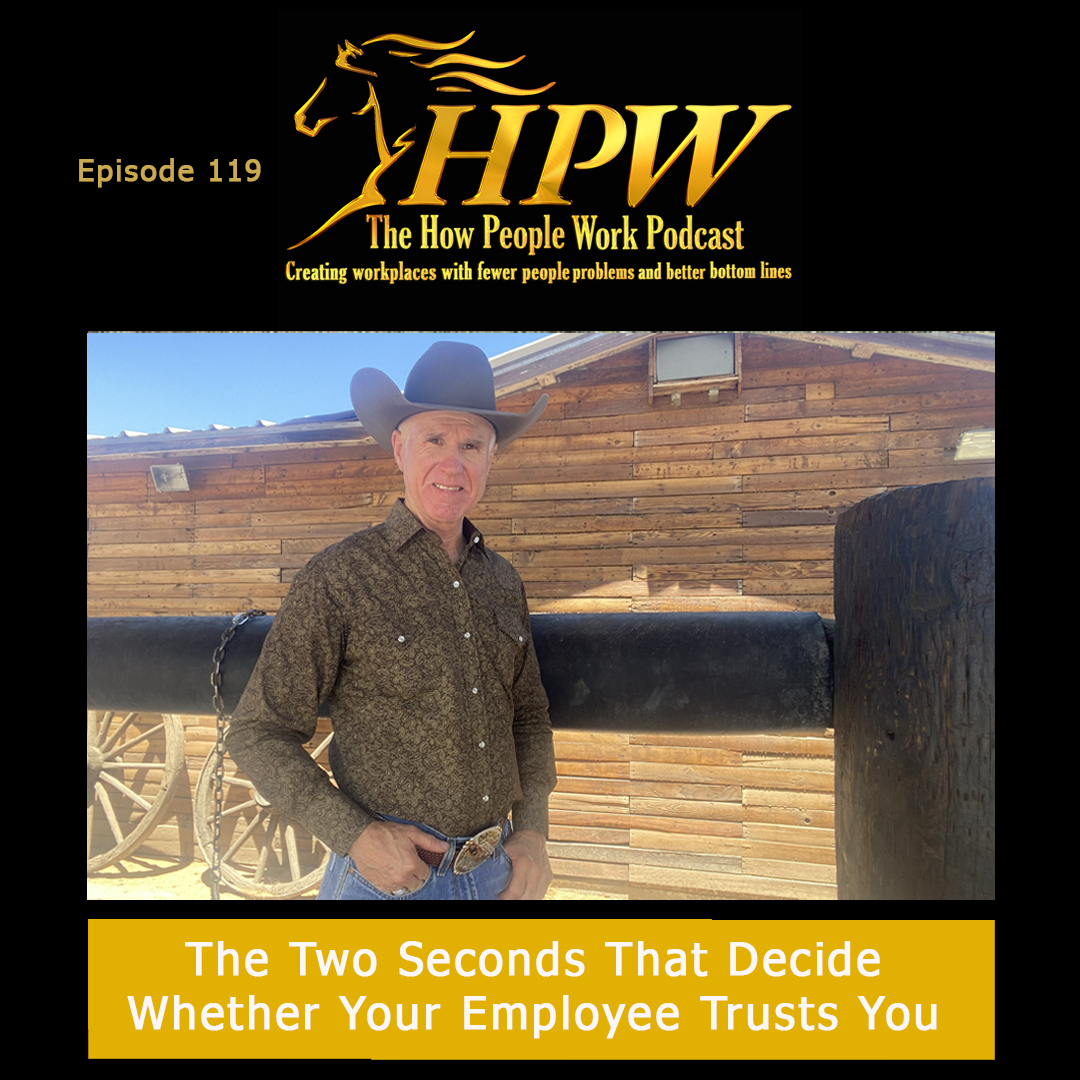
Every new employee walks into your business wondering the same thing.
"Am I going to make it here?"
They're learning a new job. They don't know your people. They don't know your standards. They don't know whether they're going to fit in.
Too many leaders make those first days harder than they need to be.
In this episode, Shane explains why new employees need more than training. They need leaders who can separate the person from the work.
The work should be evaluated.
The person should be respected.
When leaders confuse poor work with a poor person, trust disappears. People become quiet, hesitant, and afraid to make mistakes or ask questions.
When leaders protect the person while correcting the work, people learn faster, contribute sooner, stay longer, and become productive much more quickly.
Most organizations believe turnover begins months after someone is hired.
It usually starts during the first week.
A new employee is learning unfamiliar systems, meeting new people, trying to earn a paycheck, and wondering whether they made the right decision. Every interaction either increases confidence or increases fear.
When leaders attach a person's worth employees become cautious. They ask fewer questions. They hide mistakes. Learning slows. Confidence drops. Some leave before they ever reach their potential.
The business pays for it through higher turnover, slower productivity, additional hiring costs, and lost trust.
Most leadership training teaches managers how to judge performance.
Very little teaches them how to protect the person while doing it.
That difference changes everything.
The Worth Work System separates two things:
Worth
The value of the human being.
Work
The quality of behavior, decisions, skills, and performance.
Work should always be evaluated.
People should never believe their value rises and falls with today's performance.
When leaders consistently communicate that distinction, people become more willing to learn, admit mistakes, receive feedback, and improve.
Accountability becomes stronger because fear becomes smaller.
This episode is for:
If your success depends on people performing well together, this episode is for you.
In this episode, Shane shares practical leadership principles that any manager can apply immediately to improve onboarding, strengthen workplace culture, and build teams that perform at a higher level.
When leaders protect the person while correcting the work, people learn faster, contribute sooner, stay longer, and become productive much more quickly.
A little more patience.
A little more explanation.
A little more encouragement.
Those small things can make a big difference during the most important days in an employee's career.
Shane Jacob is a workplace culture speaker, leadership trainer, and creator of the Worth Work System.
After leading businesses and teams for more than 30 years, Shane teaches organizations how to reduce workplace drama, improve accountability, and create cultures built on trust rather than fear.
His message is simple.
Judge the Work. Protect the Person.
That principle changes conversations, leadership, and performance.
If your organization wants managers who build trust without lowering standards, Shane Jacob delivers keynote presentations and leadership training that give leaders practical tools they can use immediately.
His program help organizations:
Less Drama. More Trust.

Ladies and gentlemen, welcome to this episode of the How People Work Podcast. My name's Shane Jacob, your host, and I thank you for taking your time to be here with me today. There's lots of places you could be, and I'm glad you chose this one or this time. And I think you're gonna be glad you did.
So you know, today I want to talk about the difference that we can make in the workplace as managers, as leaders, as business owners, and one aspect of that, of the difference we can make, one aspect of it, with new people, new hires, the new guy or the new gal. And I, and this, as this piece of leadership, of the worth work system.
This is a piece that gets overlooked a lot, because the real deal is, employ new employees need more than just training. They really need to be, this is really the time to protect the person, to judge the work and only protect the person. Every company has turnover.
My horse feed company, Jacob Livestock here in Las Vegas, Nevada, has substantial turnover for many reasons. One of the reasons is, is that, well, we deliver, you know, a hundred plus pounds bales of hay in Las Vegas in the summer, and it's hot, and they're heavy, among other things.
But every company has some amount of turnover, have some amount of people for what, for whatever reasons, for a multitude of reasons usually, people coming and going to some degree. And the question I have is, is what determines whether those people that are coming become productive quickly, or become another hurt our turn, turnover cost, become another turnover statistic. And let me tell you, just like everything else, I learned this the hard way. I spent years getting this wrong. Okay? Hopefully so you don't have to. You can learn from all the mistakes I made. And that's what I'm here to help you get done, so that you don't have to waste allthe time and money that I did, with this one little situation, with new, with the new people. Because here's the thing, okay?
Human beings are fragile. Now, I really don't like saying that, particularly about me. But the truth of the matter, it is, is that it's a fact. Okay. And we're especially fragile during major transitions in our life. And there's not a lot of transitions that are, that we consider bigger than starting a new job, than starting a new career.
So if you put yourself back in that situation, okay, if you're not there today, go back to when you were in the job market, okay? And just thinking about, think to yourself about, you know, did you try to get interviews? Did you fill out, did you have a resume? Did you fill out applications? Did you go to interviews in person? Did you do phone call interviews? Did you do virtual interviews with a video call? Do you remember walking into a new building for the first time? Do you meet, remember meeting all the strangers that were then strangers? Do you remember wondering if you would belong, or if you belonged? Okay, because here's the thing, you know, a job isn't just income. The income is, you know, super expense, super important, but it's not the whole thing. We're there for, we need other things.
And a career, the time that we spend at a job as humans beings, the percentage of our living and breathing life that we spend in our job, is a substantial percentage of our, of our life. And so, you know, we go there to try to create the kind of life we want, we spend a substantial amount of our time there, it's our money. The stakes feel super high, okay, when you're looking and trying to find this new job.
You know, new employees have that going on plus plus plus plus, okay, just think about this, a lot of the time they're gonna have financial pressures, okay, money keeps going out but there ain't nothing coming in right now, okay, if particularly if they don't have a two, even if they do have, a if it's a family and they have more than one, half or at least part of it's gone if one of them is working.
So there's gonna be some amount of probably financial pressure, even if they don't have a tremendous amount of financial pressure, they're watching their savings dwindle. Okay, and that make, usually makes people feel insecure, nervous, worried. You know, they could have pressure at home if it's been a while and they, they're not, you know, the job hunt isn't going as quick as they want it to, or other people want it to. They could have bills that are starting, that are unpaid, that are starting to stack up.
And they're looking around going, man, is this the right fit? I wonder if these people are gonna like me. Will I fit in? Will I be able to be successful here? Will I still, will I be able to last here? Will I still have a job next month if I take this job? And a lot of us, a lot of people in the looking for work, are already judging themselves. Okay? They're already feeling bad about themselves. And not because anything that we've done as leaders, or not because anything the new company's done.
They just are, are coming in just feeling bad to start with, because thoughts that they're already having, things they could be thinking, things like, you know, I'm failing. They could be thinking that they're failing. They could be thinking that they're not capable. They might have thoughts about the last job and how it ended. They could be thinking that, you know, that they're not capable, you know, when a lot, there's a lot of thoughts wrapped up in money and earning, and when you're not, when you feel like your money is leaving, or you don't have money and you're not earning and you don't have a career, it's easy for people to go to thoughts, and therefore and then feelings, negative feelings, about how they're doing, they could just feel deficient, not good enough, not capable, you know, I'm letting my family down, and on and on and on it goes.
These are just examples of some thoughts that people can have. And they're already having these thoughts before they even show up for the interview. Okay. And so this is why good leadership matters. Okay? Because we're starting out in a very sensitive, vulnerable position with a new person, okay? And they're looking around, the new person's looking around and wondering, hey, am I gonna be accepted here? Am I gonna be evaluated? You know, and how's this all gonna go? Okay? And this is where the assimilation begins.
And new people, okay, first of all, new people's, they're not gonna be doing the job well in the beginning. Okay, so you then, you gotta add that on. They don't know your systems. Let's say you do hire, they're not gonna start out on fire. I mean, doing a great job, because they don't know your systems, they don't know your standards, they don't know your cultural, co, culture. Of course they don't. How could they? They just started. So their work isn't good, and it's not up to par yet. So it's easy for us as leaders to get frustrated with the new guy, and that's like, man, you're not fitting in, you're not getting this, I don't know.
You know, and that it's, so it's easy for us as leaders to, to confuse, it's easier, now this is natural just to start with, on a good day, with people who've been around for here for a long time, with our good employees, to judge them instead of their work, but it becomes easier and even more of a default with new people.
I catch myself, I did earlier this week, having a thought and words behind, I said some things about a new guy and I thought, wait a minute, hold on, and I caught myself, and I was making value judgments, negative value judgments, about the person instead of looking at the work and protecting the person. And it's, and it makes it a little bit easier to do that. I have to go back and fix it. Because it, it's easy to confuse poor work with poor worth. Okay?
And that's when, when we do that, and when we do that with people, mine was just, I was saying these things to myself, and it didn't, it didn't get out to a new person, but, but I think I had a chance to correct it, and so we could start off on a good foot, because this is where the trust begins. The beginning is the beginning, is very important. We're setting some foundational rules of how we roll around here, and this is the perfect time to establish the worth work principle. Okay, it's the perfect place to introduce it.
And to let people know what it means to Judge the Work, that here, here we judge the work and we always protect the person. We judge the work, but we protect the person at all times, which means we always respect and regard the per, people. We don't make negative value judgments based on what people do or don't do. Period, end of story.
Okay, and that's where we learn, and we give people that, understand the basic concept of separating what we do with who we are. We separate behavior from worth, or value as a human being. And this is our responsibility as leaders, okay, is to give new people just a little bit more. Okay. I like to give new people a little more patience, a little more explanation, a little more respect, a little more encouragement, a little bit more time, a little bit more grace, a little bit more space, and a little bit more confidence that they belong, okay? Because this is the time that they need it the most.
Here's the results. Here's the, if we can, if you can become aware, and if you can think and see what's happening with new people and just be, have the awareness of it, okay, that they're in this sensitive and vulnerable position. And if you can give them, I just like to call it a little more space and a little more grace. Okay, and by that I just mean what it meant, what it says, okay. Just a little more respect and a little more regard, and just let them know and reinforce that here we judge the work because we must, and that's what we're here for, but we always protect the person. And here's what happens when you do.
Okay, you start out with trust, they start to buy into the idea and they start to believe you, and they start to have, they start out with trust that can build and strengthen from there. The assimilation speeds up, they assimilate and become one of the team or one of the organization much quicker.
And people begin to engage sooner, you know, they're not waiting in the background, and they're not hesitant and holding all this information and ideas in, and trying to gauge, and you know, trying to control and safety up and pause and not say things just because it's safer not to say anything. They open up and they engage, and therefore you're getting the good ideas, you're getting the innovation increasing, you're getting the recommendations, you're getting the perspective of why you hired them, and they're allowing them to be as good as they can be sooner. Their ownership increases, they take ownership sooner, and by the way, their retention increases, and your turnover costs go down, because the productivity increase, the transition time is shortened. Okay.
And the profitability therefore increases. Now, and it's not because the people became different, it's because they became safe enough, they feel safe enough to contribute. In other words, when people trust that they are safe from value judgment, meaning that you're not gonna think that they're negative, that they're a certain negative way because of what they do or don't do, if they believe that they're okay, and that there, you'll always protect the person, and you won't judge the person, you'll only judge the work.
If they believe that, if they trust that they're safe from value judgment, they engage more. Okay, your engagement skyrockets, and your turnover goes down, productivity goes up. This is what was proved by Google and Project Aristotle. And these are just facts, okay? And it's the bottom line, it increases profitability, and profit is not a bad word. I mean, that's what the hell we're here for. We're here for, if we can create more profit, we're gonna have, be able to improve the quality of our lives. And that's why every one of us from the top to bottom are here in the organization doing what we can anyway. So that's, that's the result of this. And it takes a little bit of extra effort, but it works.
And it's worth it. The little bit of extra time and the little bit of extra effort pays off a hundredfold in this, in this, this example of the new people. If you give those people that, what they need in these moments when they're new, a lot of times, what happens when you don't, okay, and I know this because I was that oblivious to this for so long, for so many years. I just looked at people and I'm like, do you fit in? Are you good enough? Do you meet the requirements? And I need you to fit into this description, this box, this description that we need you to do, and I neednyou to meet the criteria, and, and do the things, and, and have thenproficiencies, and do the job, either you do it or you damn don't, you know,nand it's a, it's a poor way to go about it.
And I had a lot of value judgmentsnwrapped up in it, and I didn't give people the extra space and grace that theynneeded. And therefore, here's what happens, a lot of people won't even take thenjob. You won't get the good people, as good, a lot of the people you'll miss,because they won't even, they can feel it just like a horse.
A horse can feel what's in your heart and what's in your mind with, with, without even saying it. You know, people are getting that too. So a lot of people won't even take the job. Okay, so you're not gonna get the best people. That's number one. Second of all, good employees leave, your engagement stays low because people are afraid, they don't have the psychological safety, so they, they have fear, they'r
And so your turnover stays high. People are leaving. Okay. And everything becomes expensive because turnover is expensive and low engagement is expensive, and you're not getting the productivity that you can, and that's why it matters, okay?
Treating people like this, okay? Recognizing that people are in a sensitive, vulnerable space in their time, period, spot, and giving them just a little extra kindness, a little extra love.
I think it's morally right, yes. Okay. And I, and I hope it's how that I live, and I hope it's how people endeavor to live.
But inside of a business, these behaviors that are nice, and they make us feel good when we do them, and they make the people that we're, you know, relating to, feel better about themselves. But these behaviors, these concepts that I'm talking about, they create measurable financial results. Okay? And that's why it matters so much toa, a business. And I know because I've done it wrong, and I've seen the cost. I've judged people, I've made people feel like the outsiders.
I've watched my turnover stay higher, and as I've changed, I've watched everything automate, as I've changed, I've watched things automatically change inside my company, and that's why I'm telling you this, so you don't have to go and waste a bunch of time and money.
So I'm recommending you to consider the idea that the next person that you hire, or the next person that is the new coworker on your team, just give them a little extra patience, a little extra kindness, a little extra respect. Protect, judge the work, but protect the person. Always protect the person first while you're judging the work. Okay? And watch what happens.
Everything begins inside of you, okay, if you want people, if you want employees to believe and to trust that you're not judging their value, okay, you have to genuinely believe that they have equal value, and that starts with valuing yourself. In other words, you must commit to the pursuit of fully accepting yourself, fully forgiving yourself, seeing yourself as 100% worthy and valuable, regardless of what you have done or not done, and regardless of your behavior, you have to separate your own behavior from your own worth. And as you, at, over time, and as you develop that belief about yourself, you start to relate that to the people.
Once you believe that about yourself, you can see that in other people, you can see that they have perfect value and that they have imperfect behavior, the same as you. And as people, as you know that, and as you internalize that belief, about yourself, it starts, people, as you relate to yourself is the same way that you relate to, to others, okay, and is, and as you believe that other people have that perfect value base regardless of what they do, and I mean regardless of how bad they screwup at work, or what, or any of the thing, any behavior, period, you hear me, bar none, regardless of what they do or don't do, people can sense that.
Okay? They can sense what we really believe. That's why it matters what we believe about ourselves. And as we develop those beliefs about ourselves, and as we relate to other people, and as we give them a little bit more space and a little bit more grace when we're, when, when they're new, that's when I like to say what I call when the magic happens, okay? Because the results are truly incredible. People come out of their shells, they open up.
You get to see the results of a high trust unit, a high trust environment, a high trust workplace, a high trust relationship. It, all of an environment, a culture, a workplace, those are just like areas. It could be an empty warehouse. It doesn't matter. It's just a big office building or out at the hay yard. It doesn't matter where it's at. It's not the space. It's the individual relationships inside. That's what makes it up.
You know, several, series, or a number of individual relationships inside of a group create a feeling amongst the people that we call a culture or an environment, or, you know, a workplace.
And those high trust environments are series, bunches of numbers of individual relationships based on little teeny things that I'm talking about doing today. That, that's how they're developed. Little teeny tiny, little teeny tiny moves over time build up to create this incredible high trust unit. We'll call it team, organization, company. And it's a powerful deal, man. And you can get some stuff done with a, not a lot of people, okay.
So, that's the, that's the deal for the day, is don't be the one you don't want to be the one that overlooks how critical this is, and how important and sensitive being new, or being in the job, looking for a new job, being in the job market is. Okay. So be aware of that. You have the opportunity right here to make your organization even more amazing than it already is. Until next time, my friends, remember one thing: your value is non-negotiable.
Stay with me.


You deserve it. And you can!
Sign up for weekly tools to communicate better, connect deeper, and create more trust and love in every relationship.
Your guide to understanding yourself and the people you love on a whole new level.
Sign up here:



.png)